I’ve spent years breaking down pro matches frame by frame, and I can tell you this: esports isn’t just entertainment.
You probably think esports is for the pros. The streamers with millions of followers. The players who already made it.
Wrong.
Here’s what most gamers miss: esports creates a framework that makes you better at the games you already play. The strategies, the fundamentals, the decision-making patterns that separate top-tier players from everyone else? They’re not locked behind some talent wall.
I’ve analyzed thousands of hours of pro-level VODs and match replays. Not to watch flashy plays. To understand what actually works.
This article shows you how esports principles translate directly to your gameplay. I’ll break down how the professionalization of competitive gaming gives you a clear path to improvement.
We study meta shifts, team compositions, and core fundamentals that define high-level play. That’s how I know what separates players who plateau from players who keep getting better.
You’ll learn how esports structures competitive play in ways that benefit every player. Not just the ones on stage.
No hype about prize pools or viewer counts. Just the mechanics of how competition makes you sharper.
The Cultural Shift: Esports’ Role in the Modern Gaming Community
Remember when your parents said gaming was a waste of time?
Yeah, about that.
I watched competitive gaming go from something you did in your buddy’s basement to sold-out arenas with prize pools that rival traditional sports. And I’m not talking about small changes over decades. This happened FAST.
Here’s what most people don’t get about esports.
It’s not just about the competition. It’s about what happens around it.
When you follow a team or a player, you’re joining something bigger. You get inside jokes that only people who watch your game understand. You know the storylines. The rivalries. That moment when your favorite player clutches a 1v5 and the entire chat loses it.
That’s community. Real community.
Some folks argue that esports divides gamers instead of bringing them together. They say it makes gaming too serious and ruins the fun. I hear this a lot from casual players who just want to relax after work.
Fair point.
But here’s what they’re missing. Esports doesn’t replace casual gaming. It sits alongside it. You can still play for fun AND appreciate high-level competition. Just like you can shoot hoops with friends and still watch the NBA.
What esports actually does is give gaming a shared language.
You learn callouts. Strategies. Meta shifts. Even if you never compete yourself, understanding why esports are important Hcdesports changes how you see the games you play.
And here’s the real benefit for you.
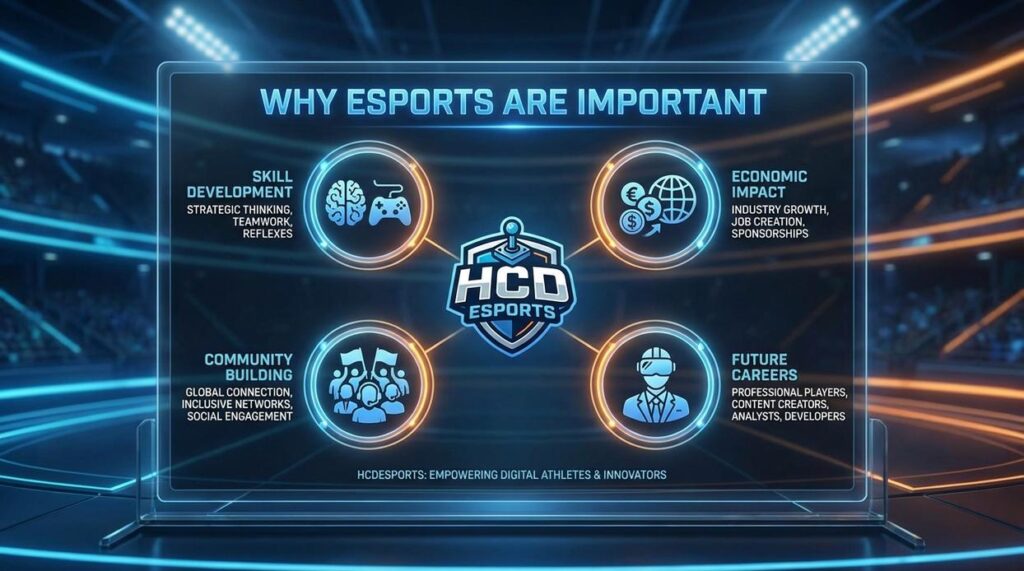
The esports ecosystem created actual career paths. Casters who break down plays. Analysts who study team compositions. Coaches who help players improve. Content creators who explain what’s happening to the rest of us.
Gaming went from “get a real job” to having real jobs WITHIN it.
That shift matters because it legitimized what we already knew. Gaming takes skill. Strategy. Teamwork. All the things people respect in traditional sports.
The prize pools just made everyone else pay attention.
The Crucible of Skill: How Esports Forges Elite Players
You know what separates a good player from a great one?
It’s not talent. It’s not the hours logged.
It’s how you practice.
I’ve watched thousands of players grind ranked matches for years and barely improve. Then I see someone climb from Gold to Diamond in six months because they changed one thing about their approach.
The difference? Structure.
Deliberate Practice Beats Mindless Grinding
Most players just queue up and play. They think time alone will make them better.
It won’t.
I talked to a former coach from a top team who put it this way: “If you’re not uncomfortable during practice, you’re not practicing. You’re just playing.”
That stuck with me.
Real practice means VOD reviews where you watch your own games and cringe at your mistakes. It means running the same drill fifty times until muscle memory takes over. It means focusing on one weakness at a time instead of trying to fix everything.
This is why esports are important hcdesports online gaming from harmonicode teaches. You need systems that work.
But here’s where it gets interesting.
Mechanics only get you so far. I’ve seen players with perfect aim stuck in Platinum because they don’t understand macro strategy. They win fights but lose games.
Micro is your mechanics. Your aim, your reaction time, your ability to execute combos. Macro is everything else. When to rotate, how to read team compositions, which objectives actually matter.
A pro once told me, “Anyone can learn to click heads. Reading the game three moves ahead? That’s what we get paid for.”
And then there’s the mental game.
You can have perfect mechanics and perfect strategy. But if you tilt after one bad round, none of it matters. I’ve seen players lose entire tournaments because they couldn’t shake off a mistake from two maps ago.
The best players I know treat mental training like physical training. They have routines for staying focused during hour-long matches. They know how to reset after losses. This connects directly to what I discuss in Online Gaming Guide Hcdesports.
That’s the real skill esports builds.
Structuring Competition: The Broader Impact on Gaming

You know what changed everything?
When esports stopped being just random online matches and became actual structured competition.
I’m talking about real leagues. Real tournaments. Real paths forward.
Before that, you could be the best player in your region and nobody would know. Now? There’s a system.
The Path to Pro Actually Exists Now
Let me show you what I mean.
A kid in Michigan (yeah, right here where I am) can play in local tournaments, get noticed in regional qualifiers, and end up competing at the national level. That’s not luck anymore. That’s a pipeline.
According to Newzoo’s 2023 Global Esports Market Report, over 540 million people watched esports content last year. Teams and scouts are watching too. They’re looking for talent in these structured events.
You don’t need connections. You need results in the right competitions.
That’s how to become an esports player hcdesports actually works now. The structure creates opportunity.
The Pro Scene Is Your Strategy Guide
Here’s something most players don’t realize.
Every major strategy you use probably came from the pro scene first.
Professional teams test new compositions and tactics in high-stakes matches. When something works, it spreads. Fast. Within days, you’ll see it in ranked games. Within weeks, it’s everywhere.
Take Valorant’s double controller meta. Started in VCT matches. Now it’s standard in competitive play across all ranks.
The pros are basically running experiments for the rest of us. They figure out what works under pressure, and we get to learn from it without risking our own tournament runs.
This is why esports are important hcdesports. The competitive scene doesn’t just entertain. It teaches.
Team Play Became Non-Negotiable
I remember when voice chat was optional.
Now? If you’re not communicating, you’re losing.
Esports codified what good teamwork looks like. Role definition matters. Callouts matter. Timing matters.
Watch any professional League of Legends match and you’ll see five players operating like a single unit. That didn’t happen by accident. It happened because structured competition rewards coordination over individual skill.
The data backs this up. A 2022 study in the International Journal of Gaming and Computer-Mediated Simulations found that teams with defined roles and communication protocols won 34% more matches than equally skilled teams without structure.
That standard trickled down to everyone.
You can’t just run around fragging anymore (well, you can, but you won’t climb). You need to know your role, make the right calls, and work with your team.
Esports didn’t invent teamwork. But it made teamwork the baseline for competitive gaming.
The Gear and Optimization Edge
I spent six months testing different mice before I found one that actually made a difference.
That’s the thing about gear. Most players think it’s all marketing hype. They say skill matters more than equipment, and you know what? They’re right to be skeptical.
But here’s where that argument falls apart.
When I switched from a 60Hz monitor to 144Hz back in 2020, my reaction time improved within the first week. Not because the monitor made me better. Because I could finally see what was actually happening.
Pro players didn’t drive the peripheral market because they’re sellouts. They did it because when you’re competing at the highest level, every millisecond counts.
Your mouse matters. Your keyboard response time matters. Your monitor refresh rate matters.
Not because they’ll magically boost your rank. Because they remove the barriers between what you want to do and what actually happens on screen.
I’ve seen players struggle for months with aim, only to realize their mouse sensor was failing. Or their sensitivity was set so high they couldn’t make precise adjustments.
The settings pros use aren’t secrets. Most of them share their configs publicly. You can find exact sensitivity numbers, crosshair placements, and graphics settings. I tackle the specifics of this in Hcdesports Gaming Guide by Harmonicode.
Start with your graphics. Turn off anything that doesn’t help you see enemies better. Motion blur? Gone. Shadows on ultra? Drop them to medium.
Your sensitivity should let you do a full 180-degree turn with one mouse swipe. Test it. Adjust until it feels natural.
Understanding why esports are important hcdesports means recognizing that optimization isn’t optional anymore. It’s part of the game.
Your Path in the New Era of Gaming
I’ve shown you how esports works as more than entertainment.
It’s the testing ground where skills get sharpened and strategies evolve. What happens at the pro level eventually shapes how everyone plays.
The distance between casual and competitive isn’t as wide as you think. You can close that gap by borrowing from the pros: structured practice sessions, reviewing your own replays, and building mental discipline.
(You don’t need to go pro to play like you care about improvement.)
Why esports are important hcdesports comes down to this: the competitive scene pushes the entire gaming world forward. New tactics get discovered. Better techniques get refined. You benefit from all of it.
Here’s what you should do next: Pick one thing from this article and apply it today. Review a recent match you played. Adjust that one setting you’ve been ignoring. Spend 20 minutes on deliberate practice instead of mindless grinding.
Start small but start intentional.
The pros didn’t get there by accident. They built habits that turned natural talent into consistent performance.
You have the same tools available. Now you know how to use them.