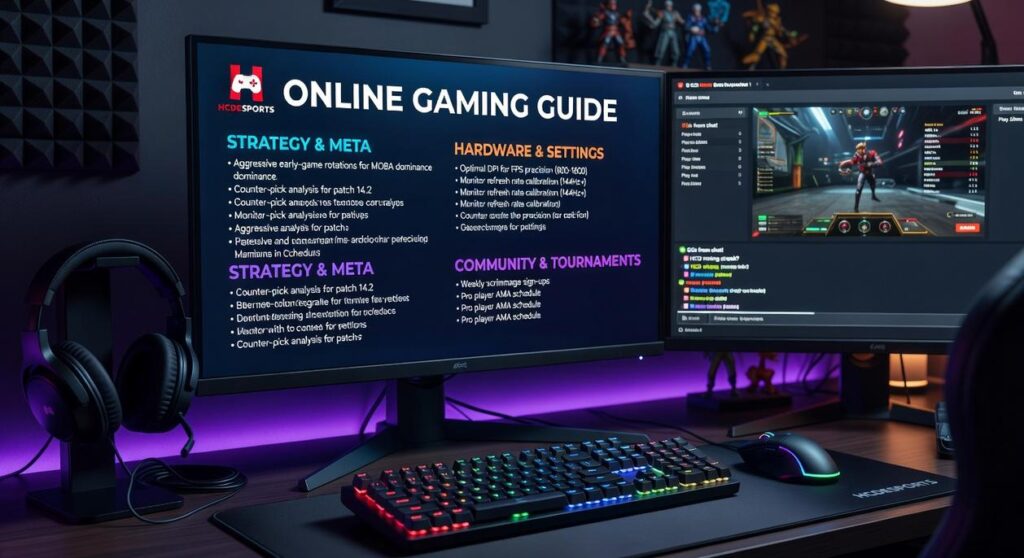
I’ve been grinding competitive games for years, and I know that moment when you start wondering if you could actually go pro.
You’re probably here because you’re good at your game. Maybe really good. But esports feels like this closed-off world where only the chosen few get in.
Here’s the truth: the gap between a skilled player and a competitor isn’t as wide as you think. But nobody tells you what that gap actually looks like.
I built online gaming guide hcdesports to break down what it really takes to compete. Not the fantasy version. The real one.
This guide walks you through the fundamentals that separate hobbyists from contenders. I’ll show you the strategic mindset pros use and the practical steps you can start taking today.
We’ve analyzed hundreds of competitive matches and studied what actually works at the pro level. That’s what this roadmap is built on.
You’ll learn what skills matter most, how to train effectively, and what your first steps should be. No gatekeeping. No vague advice about “getting noticed.”
Just the clear path from where you are now to where you want to be.
What is Esports? Defining the Competitive Landscape
I used to think esports was just kids playing video games for money.
Then I watched a friend wash out of a semi-pro League team after three months. The guy practiced eight hours a day and still couldn’t keep up.
That’s when I realized I had it all wrong.
Esports isn’t casual gaming. It’s structured competition with real stakes. We’re talking professional contracts, organized leagues, and players who treat this like any other sport.
Here’s what separates your average ranked match from actual esports.
The Difference Between Playing and Competing
When you boot up a game after work, you’re gaming. When you sign a contract, follow a practice schedule, and answer to coaches? That’s esports.
The structure matters. Professional teams have managers, analysts, and support staff (just like traditional sports, minus the physical trainers).
Some people say esports isn’t a real sport because you’re sitting down. But after seeing players burn out from the mental grind, I learned that argument misses the point entirely.
The major competitive genres break down pretty simply:
MOBAs like League of Legends dominate the scene. FPS games like Valorant test precision and tactics. Battle Royales such as Apex Legends mix survival with combat. Fighting games bring one-on-one intensity.
Each genre has its own ecosystem. Players join teams. Teams compete in leagues. Sponsors fund operations. Broadcasters stream matches to millions of viewers worldwide.
I made the mistake early on of thinking players were the whole story. They’re not. The online gaming guide Hcdesports covers this better, but the short version is this: without teams, leagues, sponsors, and fans, there’s no professional scene.
The audience drives everything. No viewers means no sponsors. No sponsors means no salaries.
It’s that simple.
Your Path to Pro: A Step-by-Step Player Development Guide
Look, I’m not going to lie to you.
Going pro isn’t a guaranteed path. There’s no magic formula that works for everyone.
But I’ve seen enough players make it (and watched plenty more fall short) to know what actually matters. The steps are pretty clear even if the outcome isn’t.
Let me walk you through what you need to do.
Step 1: Master Your Craft
Pick one game.
I know that sounds limiting. You probably play three or four titles right now and you’re decent at all of them.
Here’s the problem. Decent doesn’t cut it.
You need to be exceptional at one thing. That means choosing your game and grinding ranked ladders until the mechanics become second nature.
How long does this take? Honestly, I’m not sure there’s a fixed timeline. Some players hit high ranks in six months. Others take two years. It depends on the game, your natural talent, and how much time you can actually put in.
What I do know is this. If you’re not putting in at least 20 hours a week of focused practice, you’re probably not serious enough yet.
Step 2: Learn How to Learn
This is where most players get stuck.
They grind games but never actually improve. They hit a ceiling and can’t figure out why.
The answer is VOD review. That’s Video on Demand for anyone new to this. You record your matches and watch them back with a critical eye.
What mistakes did you make? Where did you die unnecessarily? When did you miss opportunities?
I’ll be honest though. Watching your own gameplay is brutal. You’ll see errors that make you cringe. But that discomfort is where growth happens. I cover this topic extensively in Fortnite Online Hcdesports.
Then you study the pros. Watch how they move, when they engage, how they position. The gap between your VODs and theirs shows you exactly what to work on.
Here’s what I’m still figuring out myself. How much should you copy pro strategies versus developing your own style? There’s debate in the community about this. Some coaches say mimic everything at first. Others argue you need to find what works for your strengths.
I lean toward copying the fundamentals and experimenting once those are solid.
Step 3: Enter the Arena
You can’t stay in ranked forever.
At some point you need real competition. That means tournaments.
Start with amateur online events. They’re everywhere if you know where to look. Check the online gaming guide hcdesports for current tournament listings and community resources.
Local events matter too. The prize pools are smaller but the experience is real. You’ll learn how you perform under pressure, which is completely different from solo queue.
Here’s a breakdown of where to start:
| Tournament Type | Skill Level | Benefits | Where to Find |
|---|---|---|---|
| Online Amateur | Beginner to Intermediate | Low pressure, frequent events | Battlefy, Toornament |
| Local LANs | All levels | In-person experience, networking | Facebook groups, local gaming cafes |
| Open Qualifiers | Intermediate to Advanced | Compete against semi-pros | Game-specific official sites |
| Community Cups | All levels | Regular practice, build reputation | Discord servers, Reddit communities |
Will you win right away? Probably not. I’ve seen talented players bomb their first ten tournaments before they figure it out.
That’s normal.
Step 4: Find Your Squad
Solo talent only gets you so far.
Most esports require teams. Even if you’re a mechanical god, you need people who communicate well and share your goals.
Start networking now. Join Discord servers for your game. Talk to people. Don’t just lurk.
When you’re ready, start looking for tryouts. Teams post openings in community channels all the time. Sometimes you’ll need to create highlight reels of your best plays. Other times they just want to scrim with you.
And here’s something nobody talks about enough. Sometimes you won’t find the right team. You might need to build one yourself with other hungry players.
Is that harder? Yeah. But I’ve seen new rosters outperform established teams because they had better chemistry and work ethic.
The truth is, team dynamics are messy. I can’t tell you exactly how to find the perfect squad because it’s different for everyone. What works is staying active in the community and being someone people actually want to play with.
Not just skilled. Reliable. Coachable. Someone who doesn’t tilt after one bad game (we all know that guy).
Going pro takes time. It takes sacrifice. And it might not work out.
But if you follow these steps, you’ll at least know you gave it a real shot.
The Mental Game: Adopting a Pro-Level Strategic Mindset
You can have perfect aim and still lose.
I see it all the time. Players with insane mechanics who can’t break out of their rank because they’re missing something bigger.
The mental side of competitive gaming.
Some people think the meta doesn’t matter at lower ranks. They say just focus on your fundamentals and you’ll climb. And sure, mechanics matter. But if you’re playing a character that got nerfed into the ground last patch, you’re fighting uphill for no reason.
Here’s what actually works.
Understanding the meta means knowing the Most Effective Tactic Available at any given time. It’s not about copying pros blindly. It’s about understanding why certain strategies work right now.
When a new patch drops, I read the notes. Not just skim them. I look at what changed and think about how it shifts the game. Then I watch how top players adapt. You’ll start seeing patterns in what gets picked and what gets ignored.
That awareness alone puts you ahead of most players.
But individual skill only takes you so far. The real gains come when you understand team dynamics. Every squad needs structure. Someone calls the shots (your In-Game Leader). Someone supports the team’s needs over their own stats. Someone creates space.
Figure out where you fit and own that role.
Clear communication changes everything. I’m not talking about constant chatter. I mean efficient callouts that give your team what they need to make decisions. Location. Health. Cooldowns. No toxicity. No blame. Just information.
(The best teams I’ve played with talk less but say more.)
Then there’s game sense. It’s that gut feeling about where enemies are or when to push. Some players think you either have it or you don’t. Wrong. You build it through conscious practice.
After each match, ask yourself why things happened. Why did that fight go wrong? What did you miss? Watch your replays. Notice the small decisions that led to big outcomes.
This is how you develop timing and positioning that feels natural. You start reading the flow of a match before it happens.
Want to know how to become an esports player hcdesports style? Start treating your brain like the weapon it is.
The benefit? You’ll make smarter plays under pressure. You’ll climb faster. And you’ll actually enjoy the game more because you understand what’s happening instead of just reacting.
That’s the difference between playing games and playing them well.
Gear & Optimization: Gaining Every Technical Advantage
Your gear matters.
But not in the way most people think.
I see players drop thousands on RGB setups that look incredible on stream but don’t actually help them win. They’ve got the flash without the function.
Here’s what I’ve learned. Competitive gear isn’t about looking pro. It’s about removing every technical barrier between your brain and the game. I cover this topic extensively in Why Esports Are Important Hcdesports.
Start with your monitor. You need 144Hz minimum. I run 240Hz myself, but honestly? The jump from 60Hz to 144Hz is way more noticeable than 144Hz to 240Hz. Your mileage may vary.
Your mouse should be light. I’m talking under 80 grams if possible. The sensor needs to be flawless because any acceleration or smoothing will mess with your muscle memory. Brands like Logitech and Razer make solid options, but there are plenty of others.
Mechanical keyboards give you consistent actuation points. That matters more than you’d think when you’re hitting the same keys thousands of times per session.
Now for the part nobody likes to talk about.
Settings optimization is confusing as hell. Every game handles it differently, and what works for fortnite online hcdesports might not work for Valorant or Apex.
Your goal is stable FPS above your monitor’s refresh rate. If you’ve got a 144Hz monitor, you want 144+ frames consistently. Drop your graphics settings until you get there. Competitive clarity beats pretty shadows every time.
Input lag is trickier. Turn off V-Sync. Use fullscreen mode instead of borderless. Some of this gets technical fast, and I’ll be honest, even I don’t fully understand every Windows setting that impacts latency (there are dozens).
One last thing that most online gaming guide hcdesports content skips over.
Your body breaks down faster than your gear does.
Get a chair that supports your lower back. Keep your monitor at eye level so you’re not hunching. Take breaks to stretch your wrists because carpal tunnel will end your career faster than any meta shift.
I’m not a doctor, so take this with a grain of salt. But I’ve seen too many talented players flame out because they ignored the physical side of gaming.
Your Esports Journey Starts Now
You came here wondering how to bridge the gap between casual gaming and competitive esports.
Now you know the path. It’s not some secret formula reserved for prodigies.
The journey looks intimidating at first. I get it. But think of it as a ladder you climb one rung at a time with the right approach and real dedication.
Here’s what matters most: Consistent practice on fundamentals and strategic thinking will beat raw talent every single time. I’ve seen it happen over and over.
You’ve got the roadmap from this online gaming guide hcdesports. The mechanics, the strategy, the gear choices. All of it.
Now you need to take action.
Pick one thing from this guide and do it today. Maybe you start reviewing your VODs to catch mistakes. Maybe you research an amateur league in your area. Just pick something and start.
The difference between someone who dreams about going pro and someone who actually competes? That first concrete step.
Take it now.