I’ve seen too many gamers grind for months without getting better.
You’re probably stuck at a rank that feels impossible to break through. You play for hours but your improvement has flatlined. The gap between you and the players you want to beat feels like it’s getting wider.
Here’s the truth: time spent playing doesn’t equal skill gained. Not without the right process.
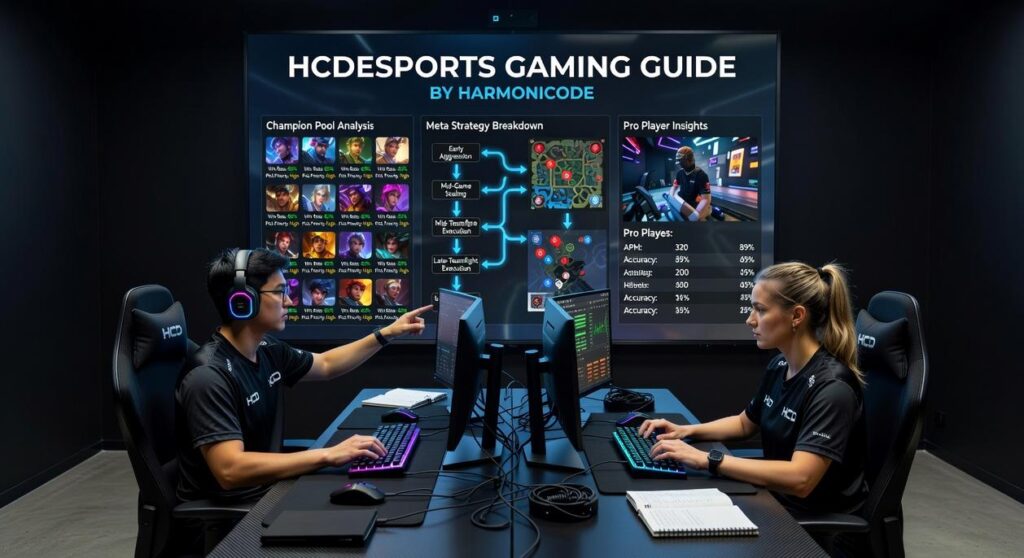
I built this hcdesports gaming guide by harmonicode after analyzing thousands of hours of pro-level gameplay. I wanted to understand what actually separates the top 1% from everyone else who’s putting in the same hours.
This isn’t about talent. It’s about having a framework that works.
You’re going to learn the fundamentals that pros build on, the strategic thinking that changes how you approach every match, and the optimization techniques that turn practice into real progress.
No fluff about mindset or motivation. Just the process that gets results.
If you’re ready to stop spinning your wheels and start climbing again, this guide will show you exactly how to do it.
Mastering the Fundamentals: The Bedrock of Every Pro Player
I was watching a stream last week when someone in chat asked the pro, “How do I get better faster?”
His answer? “Stop just playing. Start practicing.”
That hit different.
Most players grind ranked for hours thinking they’re improving. But here’s what actually happens. You’re just repeating the same mistakes over and over.
Beyond ‘Just Playing’
I talked to a coach from a tier-one team about this. He told me something I’ll never forget.
“Your brain doesn’t learn from repetition alone. It learns from deliberate repetition with feedback.”
That’s the gap between casual players and pros. Pros don’t just queue up and hope they get better. They isolate specific skills and drill them until muscle memory takes over.
Some people say fundamentals are boring. They’d rather learn advanced strats or watch VOD reviews of pro matches. And look, I get it. Aim training feels tedious compared to clutching a 1v5.
But you know what’s more boring? Losing gunfights you should win because your crosshair placement is sloppy.
Core Mechanics That Actually Matter
Let me break down two skills that translate across every competitive game.
Aim and crosshair placement. This isn’t about flicking to heads (though that helps). It’s about pre-aiming common angles so you’re already on target when someone peeks. I spend 15 minutes daily in aim trainers working on tracking and micro-adjustments. Not because it’s fun. Because it works.
Movement and positioning. A coach once told me, “Bad players run everywhere. Good players know when to walk.” Learning efficient map traversal and how to peek corners without exposing your whole body? That’s what separates you from the pack.
The Hcdesports gaming guide by harmonicode covers these mechanics in detail if you want structured drills.
Reading the Game
Here’s where most players plateau.
They nail the mechanics but their game sense stays stuck at gold level. They don’t check the minimap. They can’t predict rotations. They make decisions based on what they see right in front of them instead of reading the whole picture.
I asked a pro how he developed his game sense. His response was simple.
“I started asking ‘why’ after every death. Why was the enemy there? What information did I miss? What would I do if I were them?”
That’s it. Active thinking instead of autopilot.
You don’t need thousands of hours to build this. You need intentional practice that forces your brain to connect patterns and anticipate plays based on incomplete information.
Start there. The rest follows.
Advanced Strategy: Deconstructing the Meta Game
Everyone talks about playing the meta.
Pick the strongest characters. Copy what the pros do. Follow the tier lists.
But here’s what nobody tells you. Playing the meta is often the worst thing you can do.
I know that sounds backwards. You’re probably thinking, “If these strategies are winning tournaments, why wouldn’t I use them?”
Here’s why.
The meta exists because it works at the highest level of play. Pro teams have spent thousands of hours perfecting those compositions. They know every timing, every rotation, every counter-play.
You haven’t.
When you copy a pro strategy without understanding why it works, you’re just going through the motions. And in competitive online gaming hcdesports, that gets punished fast.
So what should you do instead?
Learn to read the meta, not follow it blindly.
Start with patch notes. When developers nerf a character’s damage by 10%, that’s not just a number. It changes matchups, timing windows, and whether that character can still fulfill their role.
Watch pro VODs, sure. But don’t just copy their picks. Ask yourself what problem they’re solving. Why did they choose that composition against that specific opponent?
The hcdesports gaming guide by harmonicode breaks this down better than most resources I’ve seen.
Here’s the part most players miss though.
Counter-meta strategies win games. If everyone’s running the same setup, they all have the same weakness. Find it. Exploit it.
Your role matters more than your pick. A support player forcing entry plays will lose. An entry fragger playing passive will lose. Know what your team needs from you and execute that (even if it’s not the flashiest role).
Gear & Settings Optimization: Gaining Every Millisecond
Let me be clear about something right away.
Better gear won’t make you a better player. I’ve seen people drop thousands on setups and still get wrecked in ranked.
But here’s what good gear actually does. It removes the stuff holding you back once you’ve got the skill.
Think of it this way. If you’re learning to aim, a 60Hz monitor won’t stop you from improving. But once you’re tracking targets consistently, that same monitor becomes a ceiling you’ll hit hard.
Some players insist gear doesn’t matter at all. They’ll point to pros who started on terrible setups and still made it. And yeah, that’s true. Skill comes first. This is something I break down further in Why Esports Are Important Hcdesports.
But those same pros? They all upgraded eventually. There’s a reason for that.
Your monitor matters most. I’m talking 144Hz minimum. The difference between 60Hz and 144Hz isn’t subtle (your eyes will notice it within minutes). Smoother motion means you can track moving targets without the stuttering that throws off your shots.
For your mouse and sensitivity, you need to find what works for you. Most pros sit between 400 and 800 DPI with low in-game sensitivity. Start there and adjust based on how much desk space you have. The hcdesports gaming guide by harmonicode breaks this down further if you want specifics.
Audio gives you information before enemies appear on screen. A decent headset lets you hear footsteps and pinpoint direction. You don’t need studio-grade equipment. Just something that separates left from right clearly. We explore this concept further in How to Get a Free Esports Bet Hcdesports.
Now for your in-game settings. Turn off everything that doesn’t help you see enemies. Shadows? Off or low. Anti-aliasing? Usually not worth the frame cost. Texture quality can stay medium if your system handles it.
Your goal is simple. Max out your FPS first, then adjust from there.
The Mental Game: Building Pro-Level Habits and Resilience
You can have perfect aim and know every map callout.
But if your mental game falls apart when the pressure hits, none of that matters.
I’ve watched players with insane mechanics completely crumble in tournament matches. Not because they couldn’t hit their shots. Because they couldn’t handle the weight of a close game.
Here’s what most people get wrong about going pro.
They think it’s all about grinding mechanics. Spending hours in aim trainers until their flicks are pixel perfect.
Some coaches will tell you that’s enough. Just keep practicing your fundamentals and the mental side will follow naturally.
But that’s not how it works.
Your brain needs training just like your aim does. The difference is that mental training feels less concrete. You can’t see your tilt resistance improve on a stat sheet.
Let me show you what actually builds mental strength in competitive gaming.
Start with a structured practice routine. Not just queuing random matches for six hours. I’m talking about a schedule that targets specific skills.
Your warm-up should include aim trainers for 15 to 20 minutes. Get your muscle memory firing before you touch ranked.
Then comes VOD review. Watch your own gameplay from yesterday. Find the mistakes you keep making. (This is harder than it sounds because nobody likes watching themselves mess up.)
Scrims against organized teams come next. This is where you practice under real pressure with your squad.
The hcdesports gaming guide by harmonicode breaks down how pros structure their practice blocks to avoid burnout while maximizing improvement.
Now here’s the part nobody wants to talk about.
Managing tilt.
When you make a bad play, your brain wants to immediately queue again and prove you’re better than that. But that’s how you spiral. One bad game becomes five because you’re playing angry.
I use a simple reset technique. After a rough match, I stand up and walk away for three minutes. Sounds basic but it works.
Know when to stop. If you’ve lost three in a row and you’re blaming teammates, you’re done for the day. Come back tomorrow with a clear head.
Your Blueprint for Competitive Excellence
You now have a complete blueprint that covers the four pillars of esports success: mechanics, strategy, optimization, and mentality.
I know the frustration of hitting a skill wall. It feels like you’re stuck no matter how many hours you put in.
But it’s not permanent.
When you adopt a structured approach to improvement, you can systematically break through plateaus and climb the ranks. That’s what this hcdesports gaming guide by harmonicode is designed to do.
Here’s what you should do next: Choose one specific area from this guide. Maybe it’s a new aim drill or a settings tweak. Focus on implementing it in your very next session.
Don’t try to fix everything at once. Pick one thing and make it stick.
The difference between players who improve and players who stay stuck comes down to deliberate practice. You have the blueprint now.
Your next session is where the work begins.